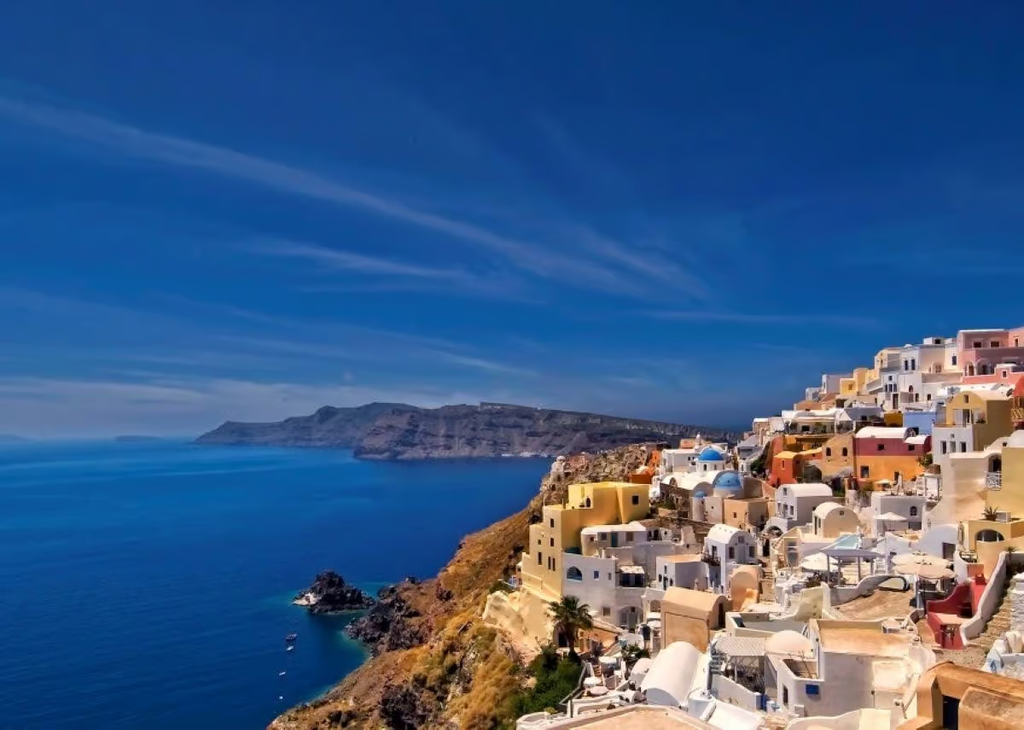
Santorini’s position as Greece’s most recognisable island escape faces fresh competition as international travellers explore alternative destinations. Summer 2026 ferry bookings reveal declines across five major foreign markets, including a 25.8% fall among British travellers and a 31.6% drop among Australians. Meanwhile, Skiathos, Sifnos and Kos offer different attractions, from pine-fringed beaches and traditional villages to extensive resort facilities. Airport statistics also reveal contrasting performances, with Santorini recording a 17.2% passenger decline in 2025, while Skiathos registered 6.8% growth. However, Greece’s national tourism receipts increased by 9.4% that year. The changing pattern raises questions about affordability, overcrowding and the future distribution of international holiday demand.
Greece’s Island Tourism Map Enters a New Phase
Greece’s summer holiday market is presenting international visitors with a broader choice beyond its most recognisable destinations. Santorini continues to command worldwide attention, yet recent booking patterns indicate that some traditional source markets are exploring different islands. The emerging competition involves more than picturesque coastlines. Accommodation costs, transport connections, beach facilities and distinctive local experiences increasingly influence holiday decisions.
The latest international ferry booking analysis reveals a particularly interesting development. Reservations made between January and July 2026 for summer journeys showed Santorini losing ground across several important international markets. The comparison covered bookings for travel between June and September, against the corresponding period in 2025. Australian bookings declined by 31.6%, followed by the United Kingdom at 25.8%, Italy at 21.4%, France at 16.6% and the United States at 14.5%.
These figures measure reservations rather than completed journeys or total tourist arrivals. Nevertheless, they provide an important indication of changing travel preferences. British and French travellers showed interest in Sifnos and Skiathos, while Italian visitors demonstrated particularly strong demand for Skiathos.
The distinction matters because Santorini remains one of Greece’s most sought-after destinations. Its position has not disappeared, but international travellers now have more reasons to consider alternatives. Consequently, the competition increasingly concerns which island delivers the most appealing combination of experiences, accessibility and overall holiday value.
National Tourism Growth Tells Another Story
Greece’s wider tourism performance provides an important counterpoint to Santorini’s changing booking patterns. The country welcomed approximately 43.31 million international travellers in 2025, representing a 6.4% increase from 2024. Travel receipts climbed by 9.4% to approximately €23.63 billion, while international overnight stays increased by 1.6%.
Average expenditure per overnight stay also rose by 7.7%, reaching €96.60. Meanwhile, average expenditure per trip increased by 2.8% to €545.50. However, the average length of stay declined by 4.5%, falling from 5.9 nights to 5.6 nights.
These figures suggest that Greece attracted more international visitors and generated higher tourism receipts despite shorter average stays. The Southern Aegean also remained particularly important, accounting for the largest regional share of travel receipts and overnight stays.
For the four islands, the national performance raises a more interesting question. Is international demand becoming more geographically distributed across Greece? The available evidence does not prove that visitors leaving Santorini are transferring directly to its competitors. However, different booking and passenger trends suggest that individual islands are experiencing increasingly varied demand.
Airport Figures Expose Santorini’s Changing Position
Airport passenger movements provide another important measure of the competitive landscape. The 2025 statistics reveal a significant difference between Santorini, Skiathos and Kos. Santorini handled 2,429,215 passengers, compared with 2,502,282 during 2024. Skiathos recorded 120,623 passengers, while Kos welcomed 503,658.
The annual changes, however, tell a more revealing story. Santorini experienced a 2.9% decline in total passenger traffic, whereas Skiathos registered 6.8% growth. Kos recorded a marginal reduction of 0.3%.
International passenger movements reveal an even sharper contrast. Santorini’s international airport traffic declined by 15.3%, from 241,678 to 204,681. Skiathos recorded a 5.7% increase, reaching 110,250 international passengers. Kos registered a 1.2% reduction, with 470,388 international passenger movements.
These figures represent passenger movements rather than unique holidaymakers. They also exclude Sifnos, which does not have a commercial airport. Nevertheless, they demonstrate that the three airport-connected destinations experienced different aviation trends during 2025.
Santorini’s performance also requires historical context. Seismic activity during early 2025 created travel uncertainty and disrupted normal visitor activity. Therefore, the decline cannot be attributed entirely to accommodation prices, overcrowding or changing consumer preferences. The distinction is important when assessing whether the island faces a temporary setback or a longer-term competitive challenge.
Skiathos Turns Its Beaches Into a Stronger Attraction
Skiathos offers a distinctly different holiday proposition for international travellers. Rather than competing through caldera views and luxury cliffside accommodation, the Sporades island builds its appeal around sandy beaches, turquoise water and pine-covered landscapes. Its coastal environment makes it particularly attractive to families, couples and visitors seeking conventional Mediterranean beach holidays.
The island’s airport performance provides encouraging evidence. Passenger traffic increased by 6.8% in 2025, while international movements rose by 5.7%. Although its overall aviation market remains considerably smaller than Santorini’s, the positive annual performance strengthens its position within Greece’s competitive summer tourism market.
Koukounaries Beach remains one of Skiathos’s defining attractions. Its golden sand, clear water and surrounding pine forest create a setting quite different from Santorini’s volcanic coastline. Lalaria attracts visitors through dramatic white cliffs and its distinctive sea arch, while Troulos and Vromolimnos offer additional swimming and watersports opportunities.
The island also has an established international holiday infrastructure. Visitors can explore beachfront accommodation, independent hotels, restaurants, boat excursions and organised watersports. This combination creates a convenient summer escape without requiring the same premium caldera-focused experience associated with Santorini.
International ferry booking patterns add another dimension. Skiathos attracted particularly strong interest from Italian travellers during summer 2026, with bookings increasing by 81.4%. British and French visitors also showed interest in the island. This does not establish equivalent growth in total arrivals, but it indicates growing attention from important European source markets.
For travellers, Skiathos offers a compelling combination of beach recreation and summer nightlife. However, visitors should expect substantial demand around famous coastal locations during July and August. Exploring quieter beaches and arranging accommodation early can help create a more relaxed holiday.
Sifnos Brings Gastronomy and Village Life Forward
Sifnos represents a different direction in Greece’s island tourism market. Its appeal lies in traditional settlements, culinary heritage, walking routes and a slower holiday rhythm. Rather than relying on large resort developments, the island offers visitors opportunities to experience local culture through food, architecture and coastal exploration.
Its gastronomic identity provides one of its strongest attractions. Traditional chickpea soup, known as revithada, features prominently in local cooking. Mastelo lamb, locally prepared sweets and traditional pottery heritage further distinguish the island from larger resort destinations.
Apollonia offers a lively centre for evening dining and exploration, while Artemonas attracts visitors through traditional architecture and narrow streets. Kastro provides an evocative historical setting overlooking the Aegean. Meanwhile, Platis Gialos and Vathi combine attractive swimming locations with waterfront restaurants and relaxed coastal accommodation.
Sifnos also offers an interesting transport advantage for travellers who enjoy island-hopping. It depends on ferry services rather than commercial aviation, connecting visitors with Piraeus and neighbouring Cycladic destinations. Passenger movements between Piraeus and Sifnos reached 187,400 in both directions during the March-to-November 2025 reporting period.
August recorded the highest monthly arrivals, with 40,056 sea passengers reaching Sifnos. July followed with 34,999, while September recorded 24,235. October arrivals declined to 6,132, demonstrating the island’s pronounced summer seasonality.
Greece’s Next Island Tourism Chapter Looks Different
Santorini’s international reputation remains a powerful tourism asset, but its position now sits within a more competitive Greek island market. Skiathos offers a compelling beach-focused proposition, Sifnos attracts visitors through gastronomy and traditional experiences, while Kos combines established resorts with extensive coastal recreation. Each destination serves a different segment of the international holiday market.
The available evidence does not establish that these islands have collectively replaced Santorini in visitor numbers. Nevertheless, international booking patterns and airport statistics reveal meaningful differences in destination performance. For Greece, the opportunity lies in encouraging visitors to explore beyond its most famous locations. The next phase of island tourism may depend less on one celebrated destination and more on the variety of experiences travellers can discover across the Aegean.