
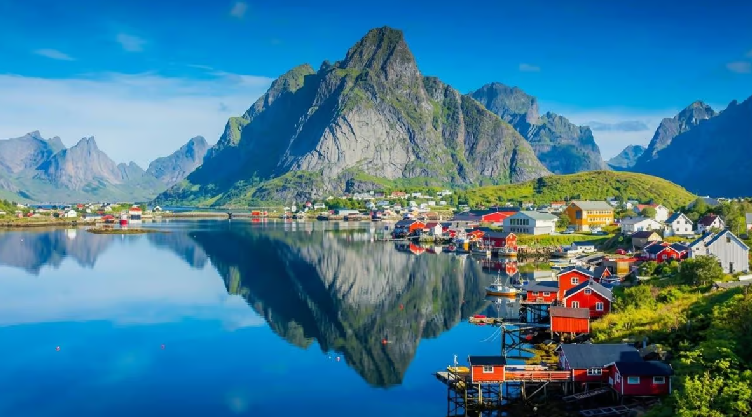
As 2026 heatwaves break records, Norway sees an exponential travel demand growth from Asia to Europe. Extreme Southern heat prompts Asian tourists to seek cooler alternatives, driving a parallel tourism surge across Finland, Sweden, Iceland, Scotland, Ireland, Switzerland, Austria, and Lithuania. There’s a massive change in travel behavior happening in the region, with people in Southern Europe increasingly looking to cooler northern countries for their summer holidays: ‘coolcationing’ is becoming a major trend in Asia. European destination searches by Asian tourists increased by 57% on a year‑over‑year basis, while hotel bookings in the Northern European region doubled, due to being driven by “climate” searches. Norway and Finland will see outbound Asian spend rise up to 8% in 2026, while visitor numbers in Iceland, and Scotland, will be up 11%, and 26% respectively, according to verified benchmarks from the European Travel Commission (ETC), UN Tourism and Amadeus travel data.
Digital Discovery Signals: How Intent‑Driven Search Sparked the Shift
The modern coolcation trend is powered by a fundamental change in digital search behavior. Instead of locking in iconic southern cities, travelers across Singapore, Hong Kong, China, and Japan are deploying climate‑first query filters.
- Condition‑First Queries: Global search volumes for terms like “somewhere cooler in Europe,” “escape the heat,” and “cool summer retreats” have surged significantly.
- Intent‑to‑Booking Alignment: Travel platforms report that travelers are filtering destinations where summer averages stay comfortably below 25°C. This high‑intent search behavior has translated into double‑digit advance bookings for Nordic and alpine regions months ahead of peak season.
Core Growth Drivers Behind Northern Europe’s Tourism Surge
The mass preference for northern latitudes is built on clear performance metrics and shifting consumer priorities:
- Thermal Safety & Comfort: Milder daily temperatures (15°C to 24°C) eliminate health risks and allow multi‑generational families to enjoy outdoor exploration without weather restrictions.
- Experiential and Slow Travel: Travelers increasingly favor scenic fjords, alpine lakes, and coastal hiking over congested, sun‑scorched urban tourist traps.
- Hospitality Expansion: A robust wave of new luxury and eco‑friendly lodging across Scandinavia and the Baltics has unlocked high‑end capacity for affluent Asian visitors.
- Top‑Tier Security: Northern European nations consistently rank at the top of global safety indexes, satisfying essential long‑haul criteria.
Finland: Lakes, Lapland, and Eco‑Luxe Hospitality
Finland has recorded significant growth in international arrivals. Asian tourists—particularly families and independent travelers—are visiting Finnish Lapland and the Lakeland region. With daytime summer highs averaging 18°C to 24°C, activities like lakeside cottage retreats (mökki), sauna culture, and the Midnight Sun draw strong interest from East Asian markets. Outbound spending to Finland from Chinese visitors is projected to grow 8% year‑over‑year, alongside a 3% increase from Singaporean visitors.
Iceland: Geothermal Wonders and Coastal Circuit Tours
Iceland remains one of the top cool‑weather destinations in Europe, posting an 11% increase in year‑on‑year bookings. With average July temperatures of 11°C to 16°C, tour operators report a sharp rise in Asian bookings for self‑drive Ring Road itineraries, volcanic geysers, and geothermal spas like the Blue Lagoon.
Sweden: Archipelagos and Sustainable Urban Breaks
Sweden is experiencing steady demand growth, with cities like Gothenburg and Stockholm serving as gateways to coastal island archipelagos. Asian visitors favor Sweden for its eco‑tourism credentials, mild maritime summer climate (18°C to 22°C), and family‑friendly cultural attractions.
Scotland and Ireland: Atlantic Coastlines and Heritage Routes
Further west, the Scottish Highlands and Ireland’s Wild Atlantic Way have emerged as primary alternatives to Southern Europe. International visitor numbers to Scotland have surged, with travelers taking advantage of daytime temperatures that rarely exceed 20°C. Scenic driving routes, historic castles, and cooler weather make the British Isles an attractive option for multi‑city Asian tour packages.
The Alpine Arc: Switzerland, Austria, and the Italian Dolomites
High‑altitude alpine regions across Switzerland, Austria, and Northern Italy offer a unique combination of cool mountain air and luxury infrastructure. While lowland Italian cities face red heat alerts, the Italian Dolomites and Swiss Alpine resorts (such as Zermatt and St. Moritz) are experiencing strong demand from affluent Asian visitors seeking elevation and temperate climate conditions.
Estonia and the Baltic States: Value‑Driven Coolcations
Estonia, Lithuania, and Latvia are capturing budget‑conscious and culture‑focused Asian travelers looking for cooler summer weather without Western Europe’s higher price points. Data shows international overnights in Lithuania rose markedly, with Tallinn’s UNESCO‑listed medieval city center gaining traction as a boutique summer destination where temperatures average 17°C to 22°C.
Source Market Dynamics: How Asian Travelers Are Adapting
- China: Outbound travel spending forecasts point to an 8% year‑over‑year increase for both Norway and Finland, driven by a growing preference for nature‑focused group itineraries and premium individual travel.
- Singapore: Outbound travel spending is projected to grow 4% for Norway and 3% for Finland. Singaporean tourists are among the most active in requesting “somewhere cooler” as their primary destination search filter.
- Japan, Hong Kong, and East Asia: Travelers from Japan and Hong Kong lead long‑haul booking conversions to Europe, with climate‑focused search queries converting directly into double‑digit booking growth toward Northern and Western Europe.
Southern European Adaptation: Responding to the Heatwave Effect
Traditional Mediterranean powerhouses—including France, Italy, Spain, and Greece—still capture the largest overall visitor volume due to deep‑rooted tourism infrastructure. However, traveler habits within these regions are evolving rapidly:
- Shoulder Season Shifts: Visitors are rescheduling Mediterranean trips to May‑June and September‑October to bypass peak summer heatwaves.
- Intra‑Country Migration: Tourists are spending less time in heat‑trapping inland cities (such as Seville, Madrid, or Florence) during peak afternoon hours, favoring coastal breezes or high‑elevation mountain escapes.
- Rethinking Daily Schedules: Guided tours are pivoting toward early morning and late evening blocks, using air‑conditioned museums and dining spaces during midday thermal peaks.
In conclusion, as extreme heatwaves sweep the Mediterranean, Norway sees an exponential travel demand growth from Asia to Europe as temperatures soar to new records in 2026. Travelers in Asia are making a deliberate move away from the sun‑drenched southern destinations and are increasingly turning to places with better weather conditions, more outdoor activities for personal comfort and a focus on wellness. This structural shift, backed by a surge in hotel stays in Northern Europe, as well as growing consumer spending, confirms that higher temperatures have not slowed long‑haul travel plans, but that European tourism is being changed for good by the reconfiguration of the geography of long‑haul vacations toward more temperate northern regions.